
The State Council recently released Decree No. 834, titled the Regulations on the Security of Industrial Chains and Supply Chains, which took immediate effect. This is China’s first administrative regulation specifically addressing industrial and supply chain security, and marks a significant elevation of supply chain security from an economic priority to a matter of national security. Here is a section-by-section interpretation and analysis of all 18 articles.
Why is this important?
It was signed by Li Qiang, the Premier of the Chinese government. This elevates these policies to the highest priority and will filter down to all government departments. This means it is binding, whether a customs official, local industrial park personnel, or a provincial leader.
Why should you care?
This is a game-changer for industry and supply chains from, and involving, China. It is an addition to previous policies such as the Anti-Foreign Sanctions Law (中华人民共和国反外国制裁法), and codifies previous regulatory guidance (both official and unofficial).
It prioritizes industrial and supply chain security as a critical component of Chinese policy. It stipulates policies such as what the government will be watching for (such as businesses notifying of shortages or companies moving capacity overseas) and the potential punishment for violating guidelines.
Also - The regulations use the term “产业链供应链” which I translate as “industrial chains and supply chains,” and conveys the idea of interconnected, sequential links in a production or distribution process.
What the new regulations say
Here is a breakdown of the policies. I have tried to translate what I could and summarize the rest (this is an unofficial translation provided for reference only. It is not authoritative and does not constitute a legal interpretation. The original Chinese text remains the sole legally binding version.) You can find the original government source at the bottom of the page.
Part One: General Provisions and Basic Principles (Articles 1-6)
Article 1 – Legislative Purpose and Basis
To prevent industrial and supply chain security risks, enhance the resilience and security level of industrial chains and supply chains, safeguard economic and social stability, and protect national security, these Regulations are formulated in accordance with the National Security Law of the People’s Republic of China, the Foreign Relations Law of the People’s Republic of China, the Anti-Foreign Sanctions Law of the People’s Republic of China, the Foreign Trade Law of the People’s Republic of China, and other relevant laws.
Analysis: This establishes a three-fold legislative purpose: risk prevention, resilience enhancement, and national security protection. Notably, the legal basis includes the Anti-Foreign Sanctions Law and the Foreign Relations Law, indicating that these regulations are positioned from the outset as part of the anti-sanctions legal toolkit, rather than just economic management regulations.
Article 2 – Working Principles
Industrial chain and supply chain security work shall implement a holistic approach to national security, balance development and security, balance domestic and international considerations, promote high-standard opening up, and facilitate the stable and smooth operation of global industrial chains and supply chains.
Analysis: This is trying to balance the legislative approach — while strengthening security, it emphasizes “high-standard opening up” and “facilitating stable global supply chains.” The regulations themselves are not aimed at self-isolation or closure, but rather at using legal means to respond to external “decoupling and supply chain disruption” pressures, and safeguarding China’s position in global supply chains.
Article 3 – Working Mechanism and Division of Responsibilities
The State shall establish a sound working mechanism for industrial chain and supply chain security, coordinating such work. The foreign affairs, development and reform, industry and information technology, public security, national security, justice, finance, natural resources, transportation, agriculture and rural affairs, commerce, financial management, customs, market regulation, and cyberspace administration departments under the State Council shall, in accordance with their respective responsibilities, be responsible for carrying out industrial chain and supply chain security work.
Analysis: This article establishes a coordination mechanism involving more than 15 government departments. This cross-departmental structure means that companies face multi-pronged, three-dimensional regulation — a single violation could simultaneously trigger anti-sanction investigations by the Ministry of Commerce, data security reviews by the Cyberspace Administration, export control enforcement by Customs, and national security reviews by the Ministry of Public Security.
Articles 4-5 – Industrial Layout and International Cooperation
The State shall guide the rational and orderly layout of industry chains and supply chains, promote the digitization and intelligence capability (智能化) of industry and supply chains, and encourage and support enterprises to diversify their supply channels.
Analysis: These two articles reflect a “dual-track strategy”: on the one hand, encouraging enterprises to diversify their layouts to reduce single-source dependencies; on the other, emphasizing international cooperation and participation in international rule-making, and being a greater influence in global supply chain governance.
Article 6 – Security Assessment in Planning
Relevant State Council departments and provincial, autonomous region, and municipal people’s governments shall, in the course of formulating relevant plans, fully consider the potential impact on industrial chain and supply chain security.
Analysis: This introduces a “security assessment at the planning stage” mechanism that requires governments at all levels to embed supply chain security considerations early in the policy-making process, reflecting a “source governance” approach.
Part Two: Core Institutional Arrangements (Articles 7-12)
Article 7 – Critical Sector List System
The State shall strengthen industrial chain and supply chain security protection for critical sectors. Relevant State Council departments shall formulate a critical sector list and implement dynamic adjustments to ensure the stable and continuous production and circulation of raw materials, technologies, equipment, and products in critical sectors.
Analysis: This is one of the core provisions. The critical sector list serves as the “switch” that triggers the entire suite of subsequent systems — information sharing, monitoring and early warning, emergency management, etc. Enterprises must continuously monitor the list’s content; once their industry is included, they will face significantly higher compliance requirements. The specific content and adjustment cycle of the critical sector list awaits further clarification.
Article 8 – Information Sharing Mechanism
Relevant State Council departments shall promote information sharing on industrial chains and supply chains in critical sectors, strengthen support for information platforms, guide information connectivity between industries and enterprises for critical-sector industrial chains and supply chains, and take effective measures to protect data security.
Analysis: This article creates some tension with Article 13 (restrictions on information collection) — on one the hand, encouraging information sharing to serve national security; on the other, strictly limiting information collection by foreign entities. This “relaxed internally, strict externally” design is intentional: data must serve Chinese regulatory purposes, not foreign compliance requirements.
Article 9 – Risk Monitoring and Early Warning System
The State shall establish a sound risk-monitoring and early-warning system for critical-sector industrial chain and supply-chain security. Relevant State Council departments... organize assessment and monitoring, identify industrial chain and supply chain security risks, and promptly issue early warnings. Enterprises, industry associations, chambers of commerce, etc., that discover situations affecting industrial and supply chain security may report them to relevant people’s government departments at or above the county level.
Analysis: This establishes a dual-track risk discovery mechanism: “official monitoring + social reporting.” Enterprises’ reporting of supply chain risks to the government is not only a right but may, under certain circumstances, evolve into an obligation. Chinese enterprises subject to foreign sanctions may formally report to the authorities under this regulation, activating the state-level protection mechanism.
Article 10 – Risk Prevention System
Relevant State Council departments shall organize physical and capacity reserves for critical sectors, increase research and development of technologies, equipment, and products, and enhance the risk-resistance capacity of critical-sector industrial chains and supply chains.
Analysis: “Capacity reserves” are a more advanced form of prevention than “physical reserves” — not only stockpiling materials but also maintaining the capacity for technological research, development, and production substitution. This aligns with China’s industrial policy of promoting breakthroughs in core technologies.
Article 11 – Emergency Management System
In the event of situations affecting critical-sector industrial chain and supply chain security, upon decision by the State Council or departments authorized by the State Council, emergency response measures may be taken, including emergency dispatch, the use of reserves, and the organization of production, transportation, and supply, etc. Relevant organizations and individuals shall cooperate with the implementation of emergency response measures.
Analysis: This grants the government broad intervention powers in emergencies, including dispatching, using reserves, organizing production, etc. The cooperation obligation is mandatory, with no “commercial reasonableness” exception.
Article 12 – Enterprise Primary Responsibility
The State encourages and guides social capital investment to support scientific and technological research and development, and to drive breakthroughs in core technologies in critical sectors... Enterprises, research institutions, etc., shall improve their risk prevention and control systems to achieve security and control of core technologies, related information systems, and data.
Analysis: For the first time, this regulation establishes, through administrative regulations, the obligation for enterprises to establish internal risk prevention and control systems.
Part Three: Restrictions on Information Collection (Article 13)
Article 13 – Prohibition on Supply Chain Information Collection
Where any organization or individual violates Chinese laws, administrative regulations, departmental rules, or relevant state provisions, and carries out surveys or other information-collection activities related to industrial chains and supply chains within Chinese territory, relevant departments shall take appropriate measures in accordance with the law.
Analysis: This is one of the provisions with the most direct impact on multinational corporations. Its scope is extremely broad.
Activities that may be covered:
- ESG audits and supply chain due diligence
- UFLPA (Uyghur Forced Labor Prevention Act) compliance reviews
- CSDDD (Corporate Sustainability Due Diligence Directive) required supply chain mapping
- Supplier assessment questionnaires and on-site factory audits
- Carbon footprint tracking and data collection
Key risk points:
- Any structured data collection related to supply chains conducted within China could fall under regulatory oversight
- If information collection has compliance with foreign sanctions as its primary or public purpose, it may be presumed to be in violation
- Cross-border data transfers must complete legally required security assessments, standard contracts, or certification procedures
Practical recommendations:
- Establish a tiered information management system, distinguishing general business information from sensitive information
- Add a Chinese legal review step to information requests from overseas customers
- Clearly define information provision limitations and Chinese legal compliance clauses in agreements with overseas customers
Part Four: Countermeasures System (Articles 14-16)
This is the serious deterrent part of the Regulations, establishing a two-layer countermeasures structure targeting both foreign governments (Article 14) and foreign commercial entities (Article 15).
Article 14 – Countermeasures Against Foreign Government Measures
Where foreign states, regions, or international organizations, in violation of international law and basic norms of international relations, adopt discriminatory prohibitions, restrictions, or other similar measures against China in relation to industrial chains and supply chains, or implement or assist in implementing acts that harm China’s industrial chain and supply chain security, relevant State Council departments have the authority to conduct industrial chain and supply chain security investigations into such measures or acts.
Countermeasures may include:
- Prohibiting or restricting the import/export of relevant goods, technologies, or international service trade
- Imposing special fees
- Including relevant organizations or individuals on the countermeasures list (linking to the Anti-Foreign Sanctions Law)
Article 15 – Countermeasures Against Foreign Commercial Conduct
Where foreign organizations or individuals, in violation of normal market transaction principles, interrupt normal transactions with Chinese citizens or organizations, adopt discriminatory measures against Chinese citizens or organizations, or carry out other conduct that causes actual harm or creates a threat of actual harm to China’s industrial chain and supply chain security, relevant State Council departments have the authority to conduct industrial chain and supply chain security investigations.
Measures that may be taken:
- Prohibiting or restricting their engagement in import/export activities related to China
- Prohibiting or restricting their investment in China
- Prohibiting or restricting organizations or individuals within Chinese territory from engaging in transactions or cooperation with them
- Prohibiting or restricting the entry of relevant personnel or vehicles
- Canceling or restricting their qualifications to work, stay, or reside in China
- Measures may penetrate to entities they control or in which they participate in their establishment
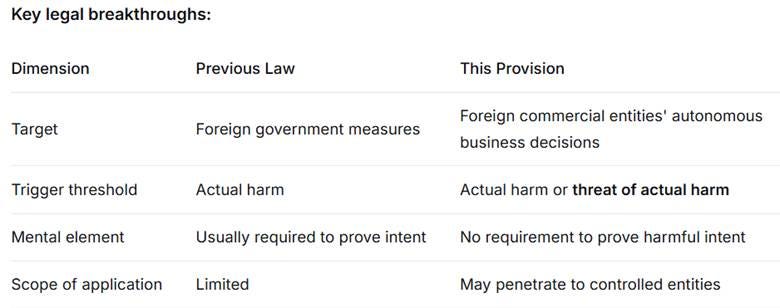
Practical implications:
- If a multinational corporation stops supplying a Chinese customer to comply with its home country’s export controls, this commercial decision alone could trigger an Article 15 investigation
- Decisions to shift supply chains from China to third countries, if deemed to “interrupt normal transactions,” may also face review
- Countermeasures may penetrate to the parent company’s global structure
Article 16 – Domestic Enforcement Obligation and Individual Liability
Organizations and individuals within the territory of China shall implement the measures taken by relevant State Council departments pursuant to Articles 14 and 15. For organizations or individuals that violate the preceding paragraph, relevant State Council departments have the authority to order correction, prohibit or restrict their participation in government procurement, bidding and tendering, and related goods, technology import/export or international service trade activities, prohibit or restrict their receipt from overseas or provision to overseas of data or personal information, prohibit or restrict their exit from China, stay or residence within Chinese territory, etc.
Analysis: This article shifts the compliance obligation from the “corporate level” down to the “individual level,” making it one of the most serious provisions in these regulations.
Penalties individuals may face:
- Exit restrictions (travel bans)
- Cancellation of stay/residence qualifications in China (significant impact on foreign executives)
- Prohibition from engaging in specific commercial activities
- Restrictions on data receipt and transmission
The “dual non-compliance” dilemma:
If a US parent company requires its Chinese subsidiary to stop transacting with a sanctioned Chinese customer:
- Complying with US instructions → violates Chinese Articles 15/16, Chinese subsidiary and executives face penalties
- Complying with Chinese law → violates US sanctions, parent company faces US penalties
This legal conflict has no perfect compliance solution. Companies must weigh risks and prepare contingency plans.
Part Five: Supplementary Provisions (Articles 17-18)
Article 17 – Legal Service Support
The State encourages and supports law firms, notary offices, and other professional service institutions in providing legal services related to industrial chain and supply chain security to Chinese citizens and organizations.
Analysis: The government recognizes the complexity of the new regulations and encourages professional institutions to participate, providing enterprises with compliance support.
Article 18 – Effective Date
These Regulations shall take effect on the date of promulgation.
Analysis: Zero transition period. This means enterprises have no buffer time and must immediately initiate compliance assessments.
Overall Analysis and Key Trends
1. Fundamental Shift in Regulatory Posture
The Regulations mark a shift in China’s supply chain security regulation from passive to active deterrence. While previous laws primarily responded to foreign government measures, Article 15 directly targets multinational corporations’ autonomous business decisions. Even if a company is “just complying with its home country’s laws,” it may trigger a Chinese investigation.
2. Systematization of the Legal Toolkit
These regulations, together with the Anti-Foreign Sanctions Law, the Unreliable Entity List, and the Blocking Rules, form a near complete anti-sanctions legal system. Companies face not a single-regulation risk but “layered” regulation — a single act could trigger multiple legal procedures simultaneously.
3. Enforcement Risk Shifts from Company to Individual
The individual penalty mechanism in Article 16 (especially exit restrictions) will fundamentally change multinational corporations’ risk assessments. Foreign executives and Chinese compliance personnel will personally bear the consequences of violations. This requires companies to grant their China teams greater independent decision-making authority in governance structures.
4. Key Uncertainties
- The specific content of the “critical sector list” has not yet been announced
- Core terms such as “interruption of normal transactions” and “discriminatory measures” are not defined
- The specific boundaries of “information collection” under Article 13 await clarification
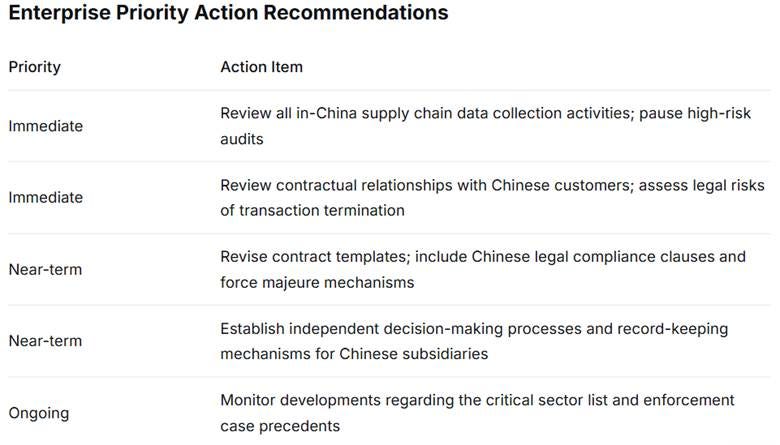
Here is to the original policy and official documentation for China’s “Regulations on the Security of Industrial and Supply Chains”: State Council Decree No. 834
Excellent thank you Cameron you’re always on point!