Five nations heavily impacted by the Iran War

These five countries share a common vulnerability:
They are small‑to‑mid‑sized economies with limited fiscal buffers, high import dependence, and exposure to global shipping and energy shocks.
1. Bangladesh — The Most Severely Hit
Bangladesh faces a triple crisis: energy, trade, and remittances.
Why is it highly exposed
Fuel import dependence: Bangladesh imports nearly all its crude and refined fuels.
Shipping disruption: Major carriers suspended cargo bookings between Bangladesh and the Gulf.
Apparel export delays: Rerouting adds 10–20 days; freight costs spike.
Remittance risk: Millions of Bangladeshi workers in the Gulf face job uncertainty.
Inflation: Oil at $110+ pushes electricity and transport costs sharply higher.
Impact severity: Very High
Bangladesh is one of the most vulnerable economies globally to this conflict.
2. New Zealand — Indirect but Significant Shock
New Zealand is not directly tied to the Gulf, but its economy is highly sensitive to global fuel and fertilizer prices.
Why it is highly exposed
Fuel inflation: NZ imports refined fuel from Asia, which depends on Gulf crude.
Fertilizer dependence: 20+% of NZ fertilizer imports come from the Gulf.
Agriculture exposure: Higher input costs hit dairy and meat exporters.
Global demand slowdown: Lower global growth reduces export prices.
Currency pressure: NZD weakens amid rising global risk.
Impact severity: Moderate–High
NZ can weather the shock, but inflation and agricultural costs will bite hard.
3. Mongolia — Hit Through China and Fuel Prices
Mongolia is indirectly exposed through China’s slowdown, commodity volatility, and fuel import costs.
Why it is highly exposed
China dependence: 90%+ of exports go to China; any slowdown hits Mongolia immediately.
Fuel import costs: Mongolia imports most of its fuel; global oil price spikes raise domestic inflation.
Commodity volatility: Higher fuel costs offset gains from copper or coal prices.
Limited fiscal space: Mongolia has little room to subsidize fuel or food.
Impact severity: Moderate–High
External shocks squeeze Mongolia:
4: Kenya - Hit from shipping delays, rising costs, and uncertainty
Kenya is one of the most exposed African economies because it relies on imported fuel and fertilizer, and because of its dependence on Red Sea shipping routes.
Why it is highly exposed
Fuel import dependence: Kenya imports nearly all petroleum products.
Fertilizer costs: Higher global fertilizer prices hit farmers and food security.
Shipping disruption: East African ports rely on Red Sea/Suez routes.
Currency pressure: The Kenyan shilling weakens, raising import costs.
Inflation: Transport and food inflation spike quickly.
Impact severity: High
Kenya faces inflation, food‑security risks, and currency stress.
5. Sri Lanka — A Fragile Economy Hit at the Worst Time
Sri Lanka is still recovering from its 2022–23 economic crisis and is extremely vulnerable to oil shocks and shipping disruptions.
Why is it highly exposed?
Fuel import dependence: Sri Lanka imports nearly all its fuel.
Debt distress: Higher oil prices worsen the fiscal deficit.
Shipping delays: Rerouting increases costs for apparel exports (a major sector).
Tourism risk: Middle East instability reduces tourist arrivals.
Inflation: Food and fuel inflation rise rapidly.
Impact severity: High
Sri Lanka is at risk of renewed balance‑of‑payments pressure.
Cross‑Country Comparison
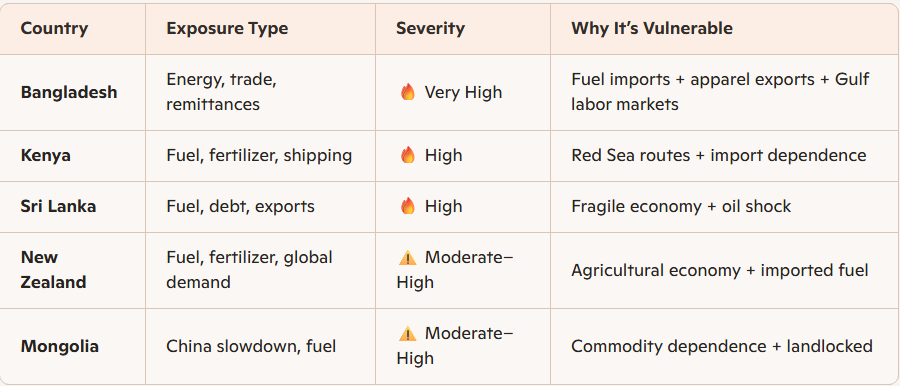
Why These Countries Are Hit Harder Than Others
They share structural vulnerabilities:
1. High dependence on imported fuel
Oil price spikes hit their budgets and inflation immediately.
2. Reliance on disrupted shipping routes
Red Sea, Gulf, and Suez disruptions hit their trade flows.
3. Limited fiscal buffers
They cannot subsidize fuel or food for long.
4. Concentrated export sectors
Apparel (Bangladesh, Sri Lanka), agriculture (NZ), minerals (Mongolia), and horticulture (Kenya) are all sensitive to shipping delays.
5. Exposure to global demand cycles
A global slowdown hits their export earnings.
Bottom Line
The Iran war is a global stress test, and these five countries are among the most exposed:
Bangladesh faces a multi‑channel crisis.
Kenya and Sri Lanka face inflation and fiscal stress.
New Zealand faces agricultural and fuel‑price shocks.
China’s slowdown and fuel inflation squeezes Mongolia.
Thoughts on how affected india might be?